Roof Leak Water Damage in Olympia, WA
The wind hit sixty at the airport overnight, a fir limb from the neighbor's yard came down on the back corner of your Northeast Olympia roof, and by morning there was a brown ring on the bedroom ceiling the size of a dinner plate. It is still raining, and the ring is bigger than it was at breakfast. This site puts you through to an independent local provider who dries out roof leak damage in Olympia and across Thurston County.
Following the water from the shingles to the ceiling
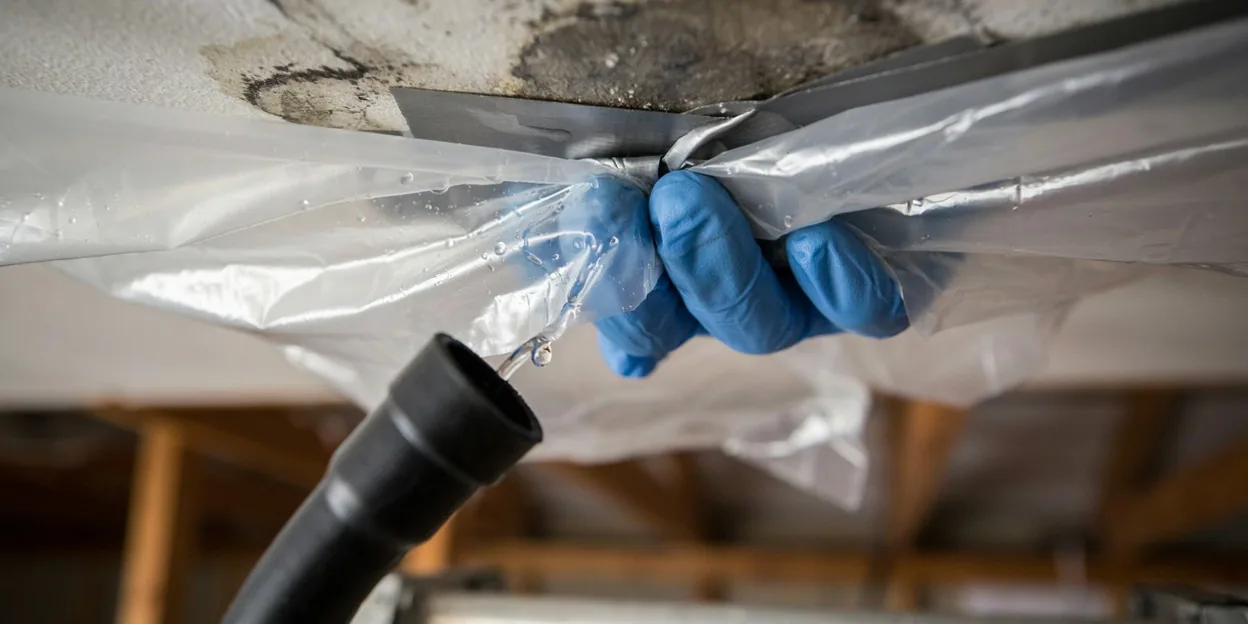
Water that gets past the roof rarely comes straight down. It runs along the underside of the sheathing, drops onto the attic insulation, soaks through, and shows up on the ceiling somewhere downhill of the hole. The crew goes into the attic first with a light and a meter to find where the insulation is wet, which is often a much larger area than the stain below. Then they meter the ceiling and the top of the walls under it, and open the ceiling at the low spot so the water drains and the cavity can dry instead of the drywall coming down on its own.
What to do while the rain is still falling
Put a bucket under the drip and poke a small hole in the center of any bulge in the ceiling so the water comes out in one place instead of spreading. Move furniture and electronics out from under the stain. If you can get into the attic safely, pull the wet insulation away from the light fixtures. Do not go on a wet roof. Call a roofer for a tarp, and call us for the inside. Photograph the ceiling, the attic, and the roof from the ground. Write down the date and the storm.
Insulation, ceilings, and what dries in place
Wet blown-in or batt insulation in the attic comes out; it does not dry in place and it holds water against the ceiling drywall and the framing. Drywall ceilings that sagged or metered wet across a wide area come down; smaller wet areas are opened and dried. Lath-and-plaster ceilings in the older houses dry more slowly but often stay if the plaster has not let go of the lath. Rafters, joists, and sheathing usually dry in place once the insulation is off them. Structural drying runs air movers in the room and a dehumidifier in the attic until the wood is back to dry. If the leak ran down inside a wall to the floor, the crew meters the floor and the crawl space too, and water extraction handles any standing water it finds.
Windstorms, moss, and why Olympia roofs leak in the dark months
Puget Sound windstorms arrive from the south and southwest between October and March, and the big ones tear shingles and drop fir limbs across the county. The December 2006 Hanukkah Eve storm, the January 2012 ice storm, and the November 2021 atmospheric river all left roofs open in Olympia and Lacey. The pre-war houses in South Capitol, Bigelow, and the Eastside have steep roofs and old chimneys, and the flashing around a 1920s chimney is often where the water gets in. The 1960s and 1970s ramblers on the Westside and around Cain Road have low-pitched roofs with long runs and wide overhangs where water pools.
Then there is the moss. Fifty inches of rain and a canopy of Douglas fir grow moss on every north-facing roof in Thurston County, and moss lifts shingle edges and dams the gutters. A gutter full of fir needles and moss overflows behind the fascia, into the soffit, and down the inside of the wall, and the homeowner sees it as a stain at the top of the wall rather than the ceiling. When the source is unclear, leak detection separates a roof leak from a supply line in the same wall.
A roof opened by wind or a falling limb is often treated as sudden damage under a homeowner policy, and the interior drying with it; a roof that has been leaking for years from moss and neglect may be treated differently. This site cannot read your policy. Have the crew photograph the attic and the ceiling and log the readings, and keep the roofer's report with them.
Calling about a leak from above
Say where the stain is, whether the ceiling is sagging, and whether the roof has been tarped. Mention the storm and the date, and whether the water reached a wall or the floor. Have the address and a number you answer ready when you call (360) 364-8868.